
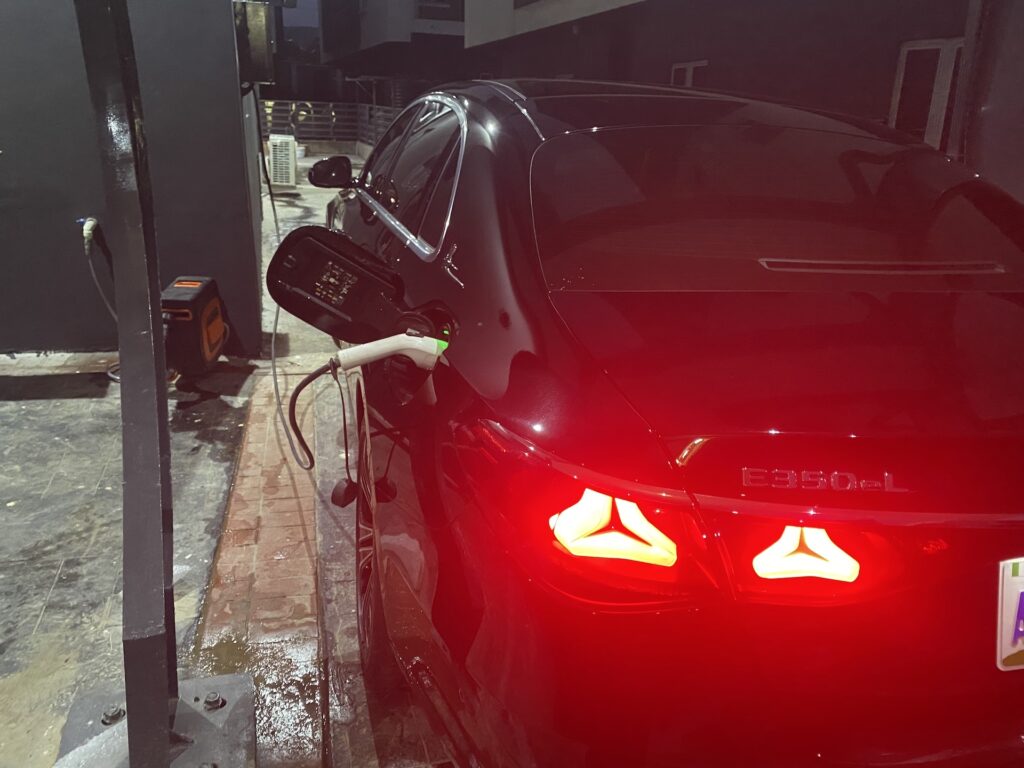
This is the question we are asked more than any other, usually before anyone asks what an installation costs. It is answerable with two published Nigerian figures and one assumption about how much electricity a car uses, so here is the arithmetic in full.
The two numbers
The National Bureau of Statistics put the average retail price of petrol at N1,596.25 per litre in May 2026, up 55.31% on the same month a year earlier. Diesel averaged N3,277 per litre over the same period.
On the electricity side, the Band A tariff applied by AEDC under the Nigerian Electricity Regulatory Commission MYTO order effective December 2025 is N209.50 per kilowatt-hour.
The assumption
A typical electric saloon or compact SUV uses somewhere around 18kWh per 100 kilometres in real driving. Your car will differ, and air conditioning in Abuja heat pushes it up. We are using 18 because it is a fair middle figure rather than a flattering one.
The result
Driving 100km on Band A electricity: 18 x N209.50 = about N3,770.
Driving the same 100km in a petrol car using 10 litres per 100km: 10 x N1,596.25 = about N15,960.
That is a difference of roughly N12,000 for every 100 kilometres, before charging losses, which typically add 5 to 10% to the electricity side.
Where it stops being true
Three things change this calculation, and any of them can change it a lot.
Your tariff band. Band A is the most expensive per unit but comes with the most supply hours. On a lower band the unit rate falls and the number of usable charging hours falls with it, which is a different problem entirely.
Charging from a generator. At N3,277 a litre for diesel, and after generator efficiency losses, electricity produced on site can cost more per kilometre than petrol in the car you replaced. If you plan to charge mainly from a generator, do the sums before you buy the car.
Solar. Once a system is paid for, the marginal cost of a kilometre falls close to nothing. Getting there takes a real array: a car doing 40km a day needs roughly 2 to 3kWp of panels dedicated to it, on top of what the house already uses. We set out how that pairs with a charger on our solar and inverter-backed EV charging page, and Abuja Solar & Energy Company covers the array and storage side of the same job.
What this means for the charger on your wall
The running-cost gap is large enough that the installation pays for itself over a reasonable period for most drivers. What it does not do is justify a bad installation. A charger on a shared ring, without DC-fault protection and without a measured earth, is cheap for exactly as long as nothing goes wrong.
Installation cost differs from job to job. Call 0706 727 6002 and we will be on site for inspection and evaluation within 6 hours, anywhere in Abuja, and you will get a written quote with the full cost broken down line by line.
Sources: National Bureau of Statistics petrol and diesel price watch, May 2026. Nigerian Electricity Regulatory Commission MYTO order effective December 2025 as applied by AEDC.
Thinking about a charger, or worried about the one you have?
We are on site for inspection and evaluation within 6 hours anywhere in Abuja. You get a written quote with the full installation cost broken down line by line, and once it is agreed and paid we begin work immediately.