
Solar and Inverter-Backed EV Charging in Abuja
Charging a car from the sun is entirely possible in Abuja. It is also the part of this trade where people are sold the most nonsense. A car is a very large load compared with a house, so the arithmetic has to be done honestly before anything is bought.
We size the inverter, battery and array against your actual driving, not a brochure. On site for inspection within 6 hours, anywhere in the FCT.

The arithmetic nobody does before buying
Three numbers decide whether solar charging makes sense at your house: how far you drive, how much sun your roof actually gets, and what your inverter can hold continuously.
Start with how far you actually drive. A typical electric saloon or compact SUV uses roughly 0.18kWh per kilometre. Forty kilometres a day, which covers a great many Abuja commutes, is therefore about 7kWh a day at the wheels, and closer to 8kWh once charging losses are included.
Abuja receives roughly 5 to 5.5 kWh per square metre per day of solar irradiation on average across the year. In practice a well-installed fixed array here yields in the region of 4 to 4.5kWh per day for every kilowatt-peak of panels, before dust and seasonal variation.
So a 40km-a-day car needs roughly 2kWp of panels dedicated to it, and closer to 3kWp if you want that to hold up through the harmattan haze and the cloudy weeks of the rainy season. That is on top of whatever the house already uses. It is achievable. It is not a couple of spare panels.
The inverter is the other half. A 7.4kW charger draws 7.4kW continuously for hours. A 5kVA inverter cannot do that. If you want the charger to run from the inverter at full power, the inverter has to be rated for it continuously, not at peak, and the battery has to be able to deliver that current without collapsing.
The alternative, and often the better answer, is a charger that can be told to draw less. Many units support a configurable current limit, so the car charges at 3.7kW from the inverter overnight and at 7.4kW when the grid is up. That single setting removes most of the cost of doing this properly.
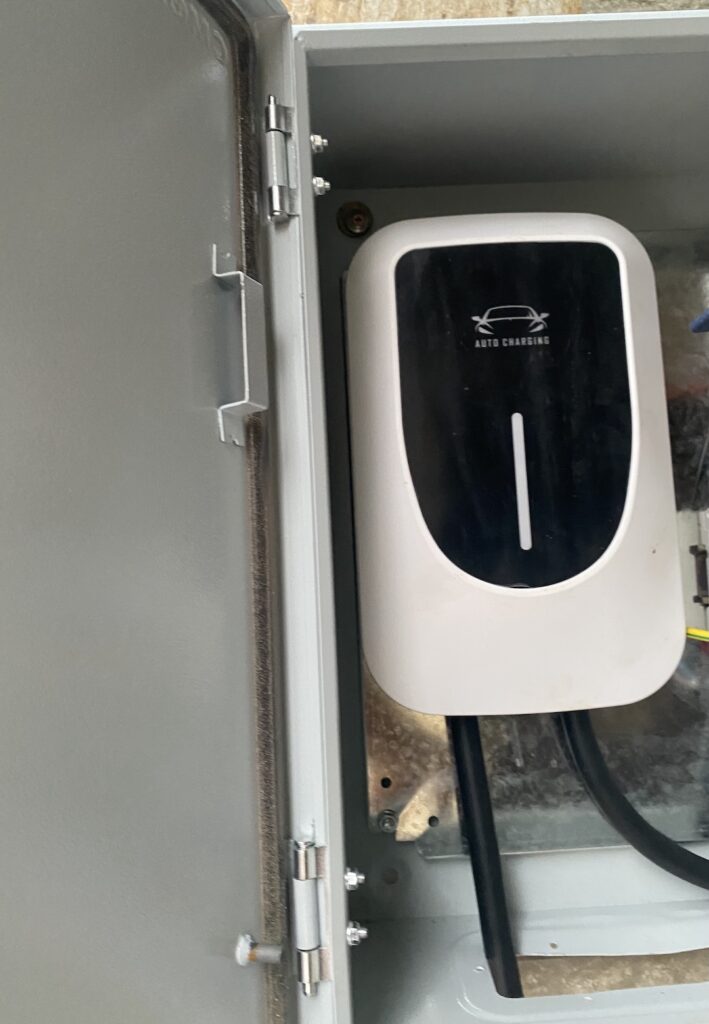
How we design a solar-backed charging setup
The order matters. Sizing the array before understanding the load is how people end up with an expensive system that still cannot charge the car.
- Measure the daily driving distance and convert it into kWh at the wall, including losses
- Establish the existing house load, so the car is not competing with the fridge and the boreholes
- Check roof orientation, shading and available area against the array size the car actually needs
- Size the inverter for continuous charger load, not peak rating on a sticker
- Size the battery for the depth of discharge you want overnight, and its continuous discharge current
- Set a current limit on the charger so it behaves differently on inverter than on grid
- Arrange the changeover so the charger always sees a clean supply with a proper neutral reference
- Commission with a real charge session on both grid and inverter before handover
Why people ask for this in Abuja
The case is not ideological here. It is arithmetic about fuel, tariffs and supply hours.
N1,596
Average petrol price per litre, May 2026
National Bureau of Statistics
N3,277
Average diesel price per litre, May 2026
National Bureau of Statistics
N209.50
AEDC Band A grid tariff per kWh
NERC MYTO, from December 2025
4,000MW
Typical national generation against far higher demand
EV24 Africa, 2026
Straight answers
What we will tell you honestly
Charging entirely from solar is a large system. If someone quotes you a small array and promises a full car every day, they are selling a number, not a design. The array, battery and storage side of a design like this is covered in more depth by Abuja Solar & Energy Company.
Hybrid is usually the right answer. Grid when it is there, inverter and battery when it is not, solar reducing what you buy. That covers the real failure mode in Abuja, which is not the absence of grid so much as its unpredictability.
A generator can charge a car, but do the sums first. At current diesel prices, charging from a generator can cost more per kilometre than petrol in the car you replaced. Sometimes it is still worth it for the convenience. It should be a decision, not an accident.
Lead-acid batteries are the wrong tool. The discharge currents and cycle counts involved in car charging will destroy them quickly. Lithium, correctly sized, or nothing.
What our customers say
Rated 5.0 out of 5 from 3 Google reviews. Read every one of them, unedited, on our Google Business Profile.
“Great service and fast response I will give you guys a 9/10.”
Finding the charger: very easy
Kekeboro Obarijima · Google review
“Had a smooth charging experience at this Abuja EV charger installation, very user friendly. The fast electric vehicle charging and reliable public EV power make it the best spot in the FCT. Will definitely be back.”
john mmoh · Google review
“Great service.”
HID ACADEMY · Google review
Solar charging questions
Not covered here? Ask on the phone. It is quicker than guessing.
Not directly. The panels feed an inverter and usually a battery, and the charger runs from that. What you can do is set the charger to draw only what the system can comfortably supply, so it charges gently through the day rather than trying to pull 7.4kW at four in the afternoon.
For roughly 40km of driving a day, in the region of 2 to 3kWp of panels dedicated to the car, on top of what your house already uses. This is an estimate from Abuja irradiation figures and typical yields, not a promise. Your roof, shading and driving change it.
One rated to deliver 7.4kW continuously, not at peak, together with a battery that can sustain that discharge current. If that is more inverter than you want to buy, the practical answer is to limit the charger to 3.7kW on inverter supply.
It can, if the inverter is undersized. A car charger is a long, flat, heavy load, quite unlike a house. Running an inverter at or above its continuous rating for hours every night shortens its life. Size it properly or limit the charger.
Often yes, with a current limit on the charger and sometimes an additional battery. We would rather assess what you have than sell you a second system.
Charging from Band A grid electricity at N209.50 per kWh works out at roughly a quarter of the cost of petrol at May 2026 prices for the same distance. Solar reduces it further once the system is paid for. Generator diesel can be more expensive than petrol, so it depends entirely on which source you charge from.
We design and install the charging side, and we work with the solar and inverter side so the two are sized together. If you already have an installer, we will work to their equipment rather than around it.
Yields drop, so a system designed only for the sunny months will disappoint. We size for the worst realistic month or, more commonly, design a hybrid that leans on the grid when the sun is not cooperating.
Tell us your daily distance and what you already have
Kilometres a day, the inverter and battery you own if any, and roughly how much roof you have. That is enough for us to tell you whether solar charging is realistic at your house.
On site for inspection within 6 hours, anywhere in the FCT. Open 24 hours, seven days a week.