
EV Charger Installation Cost in Abuja
Installation cost differs from job to job, and anyone who quotes a single figure over the phone without asking about your board, your earth and your cable run is guessing. What follows is exactly what moves the number. When you are ready, we survey and send you a written quote with the full installation cost broken down line by line, so you can see what each part costs.
Installation cost differs from job to job. Call 0706 727 6002 for a quote with the full breakdown.
The seven things that decide your price
These are listed in rough order of how much they move the final figure on a typical Abuja home installation.
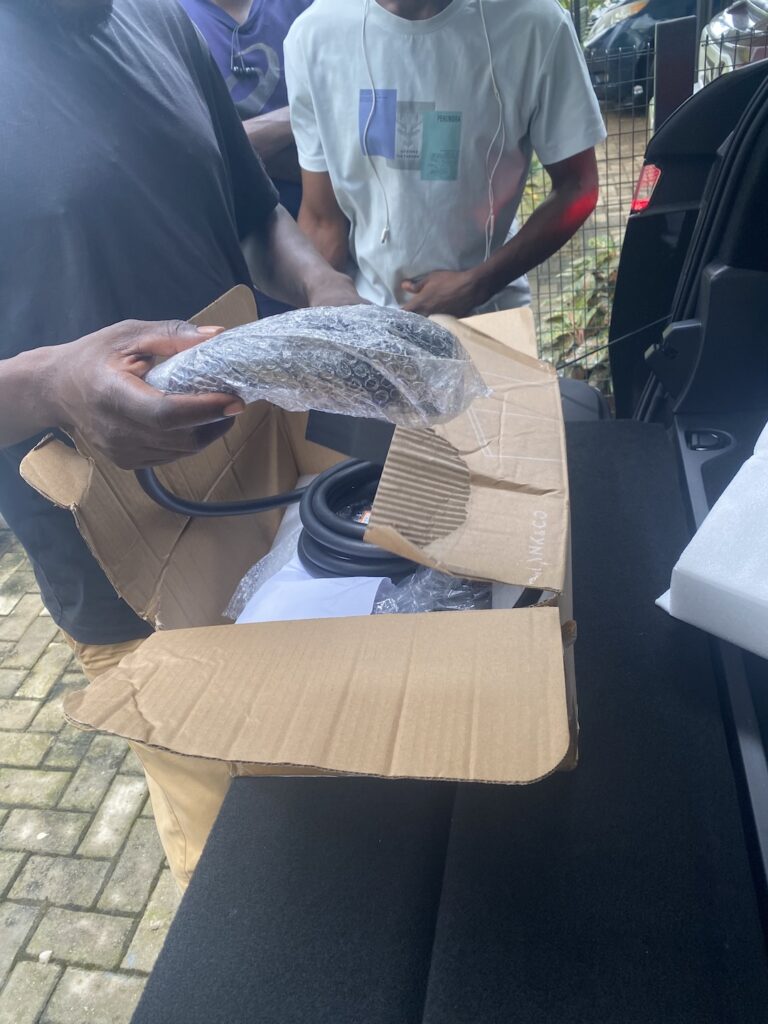
1. The charger itself. A 7.4kW single-phase unit, a 22kW three-phase unit and a DC rapid charger are different orders of cost. Within AC units, price tracks build quality, ingress protection, whether DC fault detection is built in, and whether it has load management and metering.
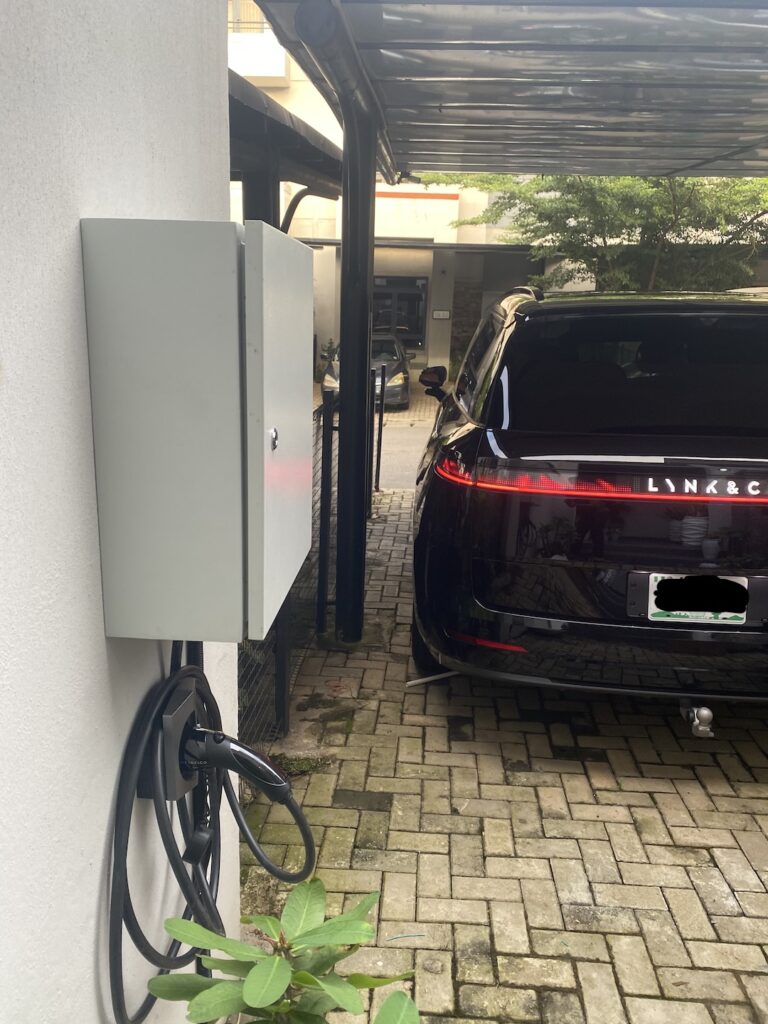
2. Cable length and size. The single biggest variable on Abuja jobs. A charger five metres from the board is a different job from one at the far end of a 45 metre compound, because the cable has to grow to keep voltage drop in check, and cable is sold by the metre.
3. The route. Surface-clipped along an existing wall is cheap. Trenching across a paved driveway, coring through a block wall, or running in conduit under interlocking stone is not.
4. The state of your earthing. If there is a tested electrode with acceptable impedance, nothing to do. If there is not, a rod has to be driven and tested, and in dry laterite that occasionally means more than one.
5. Spare capacity at the board. A board with a free way and headroom is straightforward. A full board needs a new way, sometimes a sub-board, occasionally a conversation about the incoming supply.
6. Whether you want it to work during an outage. Adding a changeover, or sizing an inverter to hold the charger, is a separate decision with a separate cost. It is often the largest line if you say yes.
7. Where you are. We work FCT-wide, and travel to the far side of the territory is factored in honestly rather than hidden.
What it costs to run, once it is installed
This is the calculation most people actually want. It uses two published Nigerian figures and one typical consumption assumption, and we show the full working in what it costs to charge an electric car in Abuja.
| Driving 100km in Abuja | Cost | Where the number comes from |
|---|---|---|
| Petrol saloon at 10 litres per 100km | about N15,960 | N1,596.25 per litre, NBS national average, May 2026 |
| Electric car at 18kWh per 100km on Band A grid | about N3,770 | N209.50 per kWh, AEDC Band A, NERC MYTO from December 2025 |
| Electric car charged from a diesel generator | higher than petrol | N3,277 per litre diesel, NBS May 2026, before generator efficiency losses |
| Grid saving versus petrol | roughly N12,000 per 100km | Before charging losses, typically 5 to 10% |
Two things follow from this. First, the installation is not really the cost question: the running cost is, and on grid electricity it is dramatically lower than petrol at current prices. Second, if you plan to charge mostly from a generator, the arithmetic reverses, and you should know that before you spend anything.
How to get a real figure quickly
We can usually give a close estimate on the phone if you have these five things to hand. A site visit confirms it.
- Your car: make, model and whether it charges on Type 2 AC
- A photo of your distribution board with the cover off if it is safe to do so
- Roughly how many metres from that board to where the car parks
- Your district or estate, and whether it is a shared transformer
- Whether you have an inverter or generator, and its rating
- Your tariff band, if you know it, or a recent bill
Where we will tell you not to spend money
On a 22kW charger with a single-phase supply. It will charge at 7.4kW regardless. You would be paying for a number on a sticker.
On DC rapid charging at a site where cars park for hours. Offices, hotels and estates almost never need it. It costs several times more per bay and loads your supply for speed nobody uses.
On a large inverter purely so the car can charge at full power during outages. Setting a lower current limit on the charger achieves most of the benefit for a fraction of the cost.
On replacing a charger that is not the problem. Most faults we are called to are in the circuit, the earth or the protective device. Replacing the box leaves the fault in place.
What our customers say
Rated 5.0 out of 5 from 3 Google reviews. Read every one of them, unedited, on our Google Business Profile.
“Great service and fast response I will give you guys a 9/10.”
Finding the charger: very easy
Kekeboro Obarijima · Google review
“Had a smooth charging experience at this Abuja EV charger installation, very user friendly. The fast electric vehicle charging and reliable public EV power make it the best spot in the FCT. Will definitely be back.”
john mmoh · Google review
“Great service.”
HID ACADEMY · Google review
Because the honest range on an Abuja home installation is wide, and the variables that move it are things we cannot see from here: your earth, your board, your cable run and your supply. A published price would either be so high it puts off simple jobs or so low it would have to change after the survey. We would rather quote you properly.
Ring 0706 727 6002 and ask. It depends where you are in the FCT and how much of the answer we can give you on the phone first, which is often quite a lot.
No. After the survey you get a written quote with the full installation cost broken down line by line: the charger, the cable and its route, the protective device, any earthing work, any changeover or stabiliser, and the labour. Installation cost differs from job to job, so the breakdown is the point. It shows you which lines are driving your figure.
Yes. We will check that it is suitable for your supply and that it either has DC fault detection built in or can be protected by a Type B device, and we will install it. We warrant our workmanship; the unit’s warranty stays with whoever you bought it from.
For larger commercial work, yes, staged against milestones. Discuss it when you call.
On grid electricity at Band A rates, substantially: roughly a quarter of the fuel cost of a petrol car for the same distance at May 2026 prices. On generator diesel, no. Where you charge matters more than what you drive.
There is no single figure, and anyone quoting one before seeing your board is guessing. The cost is driven by the cable run from the board to the parking bay, whether the board has a spare way and spare capacity, the state of your earthing, and whether you want the charger to work during an outage. We inspect within 6 hours and send a written quote with every line broken out.
Portable chargers start from N750,000, with other models from N950,000. Fixed wall chargers vary by brand and rating, so we quote the unit alongside the installation rather than publish a list that goes stale. Message us on WhatsApp for the current price of any specific model.
The installation work is much the same as any other Type 2 wall unit, so the labour and materials sit in the same range. The difference is the price of the unit itself. We quote the two separately so you can see exactly what you are paying for.
Get a real number, not a guess
Call or send a WhatsApp message with your car, your district and a photo of your distribution board. Most quotes start and finish in one conversation.
On site for inspection within 6 hours, anywhere in the FCT. Open 24 hours, seven days a week.