
EV Charger Repair and Maintenance in Abuja
A charger that trips, cuts out at 2am or throws an earth fault is almost never a broken box. In the work we do across the FCT, the fault is usually in the circuit behind it: a shared ring, an untested earth, the wrong protective device, or a changeover the charger cannot see. We diagnose the installation, not just the unit.
We repair chargers other companies installed, and we are with you within 6 hours anywhere in the FCT. Call 0706 727 6002.
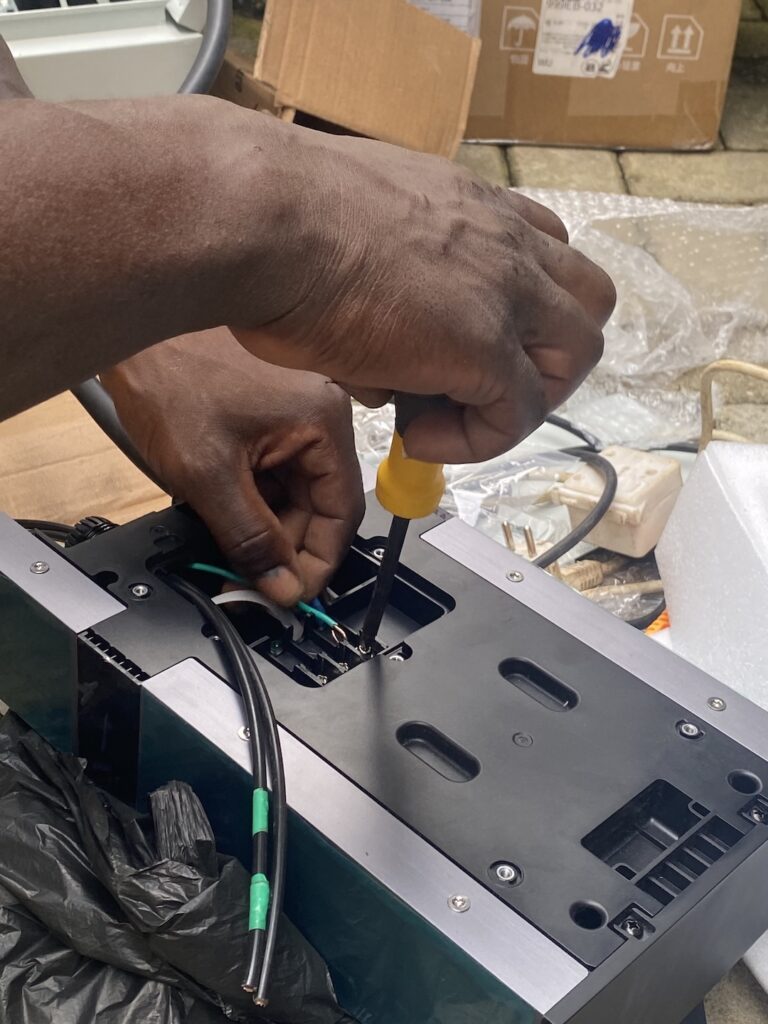
Symptoms, and what they usually mean
If any of these sound like your charger, the description below is the shortlist we work through on site.
The charger trips the house. Most often it is not on a dedicated circuit and is sharing with an air conditioner, a pump or a freezer. Sometimes it is a protective device with the wrong rating or the wrong type.
It stops charging at low voltage and will not restart. Undervoltage lockout. The unit is doing its job. The fix is at supply level: a stabiliser, an inverter buffer, or a different charging window.
Earth fault or residual current trip. Moisture in an outdoor enclosure, a damaged cable run, an earth electrode that has dried out, or an AC-type RCD reacting to DC leakage it was never designed to see.
It charges far slower than it should. Undersized cable over a long compound run, a derated setting left at commissioning, a hot connector, or a car limiting itself for its own reasons.
The connector is loose, hot or discoloured. Connector wear is real, particularly on a shared or public unit. Heat marks mean stop using it now.
It will not pair with the app, or lost its settings. Firmware, Wi-Fi range, or a unit that was never properly commissioned. Frequently a twenty-minute fix.
It works on grid but not on generator or inverter. A changeover that leaves the charger without a proper neutral reference, or an inverter that cannot hold the continuous load. This is a design fault, not a charger fault.
It worked for months and then stopped. Dust ingress after harmattan, water after the rains, an insect nest in an enclosure, or a terminal that was never torqued correctly at installation and has slowly worked loose.
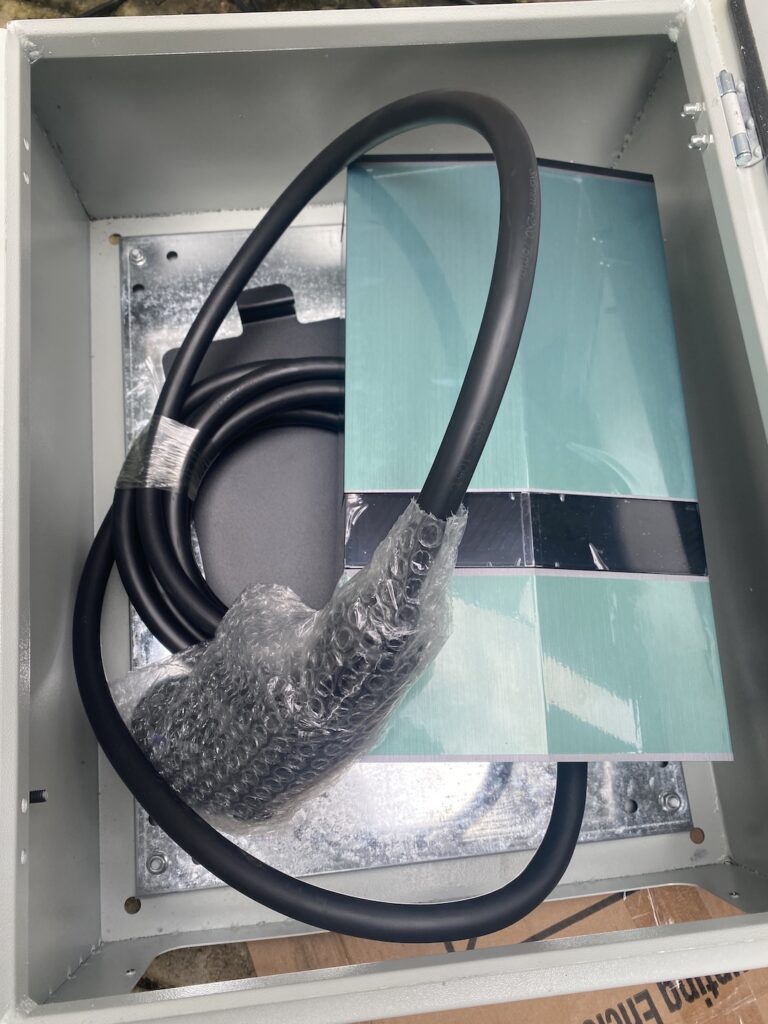
What a diagnostic visit covers
We test rather than guess, and you get the readings whether or not you use us for the repair.
- Supply voltage under load, and a check for undervoltage or imbalance across phases
- Earth loop impedance and continuity of the protective conductor
- Insulation resistance on the charger circuit
- RCD or RCBO trip time and type, including whether DC fault detection is present at all
- Cable size against the actual run length and the charger rating
- Terminal temperature and torque at the board, the isolator and the charger
- Enclosure sealing, glanding, and evidence of dust or water ingress
- A live charge test with the vehicle, and the charger’s own error log where it keeps one
The one fault we find most often
Residual current protection is the item most frequently missing or wrong on installations we are called to fix. A standard AC-type RCD cannot detect the smooth DC residual current that an electric car’s onboard charger can produce under fault conditions, and once that DC component is present, the AC-type device can be blinded and fail to trip on a subsequent AC fault.
IEC 61851-1 addresses this directly: an EV charging point requires detection of DC fault current at 6mA, provided either by a Type B RCD or by DC fault detection built into the charger itself. Plenty of units sold here do have it built in, and plenty do not. Nobody checks, because nothing appears to be wrong until the day something is.
If you take one thing from this page: ask whoever installed your charger which of the two you have. If they cannot answer, that is the answer.
Servicing
Maintenance, and why outdoor units here need it
Abuja is hard on outdoor electrical equipment in two distinct seasons. Harmattan drives fine dust into anything not properly sealed, and it settles on terminals and contacts. The rains find every gland that was not tightened and every enclosure fitted with the cable entry facing upward.
On top of that, connectors are mechanical parts. A charging connector inserted and removed twice a day for two years has thousands of cycles on it, and the pins wear. On public and shared units, add strangers who do not treat the cable gently.
A sensible schedule for a home unit is an annual inspection. For a commercial or public site, twice a year, with a connector check between. It takes an hour and it is the difference between a worn contact and a burnt one.
What our customers say
Rated 5.0 out of 5 from 3 Google reviews. Read every one of them, unedited, on our Google Business Profile.
“Great service and fast response I will give you guys a 9/10.”
Finding the charger: very easy
Kekeboro Obarijima · Google review
“Had a smooth charging experience at this Abuja EV charger installation, very user friendly. The fast electric vehicle charging and reliable public EV power make it the best spot in the FCT. Will definitely be back.”
john mmoh · Google review
“Great service.”
HID ACADEMY · Google review
Repair questions
Not covered here? Ask on the phone. It is quicker than guessing.
Yes, that is most of this work. We do not need to have supplied the unit, and we will tell you honestly if the problem is the installation rather than the charger.
It depends on where you are in the FCT and what the site involves. Call 0706 727 6002 with your location and a description of the fault and you will get a figure before anyone drives out.
A device that trips is protecting you, so it is doing the right thing. What is not safe is resetting it repeatedly without finding out why, or worse, replacing it with a higher-rated device to stop the nuisance. Stop using the charger and have it looked at.
Often yes. Tethered cables and connectors are replaceable on most units, and it is far cheaper than a new charger. Whether it is worth it depends on the unit’s age and whether parts are available in Nigeria.
Usually not. It is normally Wi-Fi range from the house to an outdoor unit, a router change, or a commissioning step that was skipped. It is one of the quicker calls we get.
Frequently. Moving the charger to its own dedicated circuit, fitting the correct protective device, driving a proper earth electrode or re-sizing the cable will fix most of what we see, and the charger itself stays.
Yes, on a schedule. Public equipment takes far more abuse than a home unit and should be inspected at least twice a year, with connectors checked more often.
We will say so plainly and tell you what a replacement involves, including whether your existing circuit and protection can be reused. We would rather lose a sale than sell you a repair that will not hold.
Describe the fault and we will tell you what it usually is
Most of our diagnostic calls start with a photo of the distribution board and a sentence about when the charger stops. Send both on WhatsApp.
On site for inspection within 6 hours, anywhere in the FCT. Open 24 hours, seven days a week.