
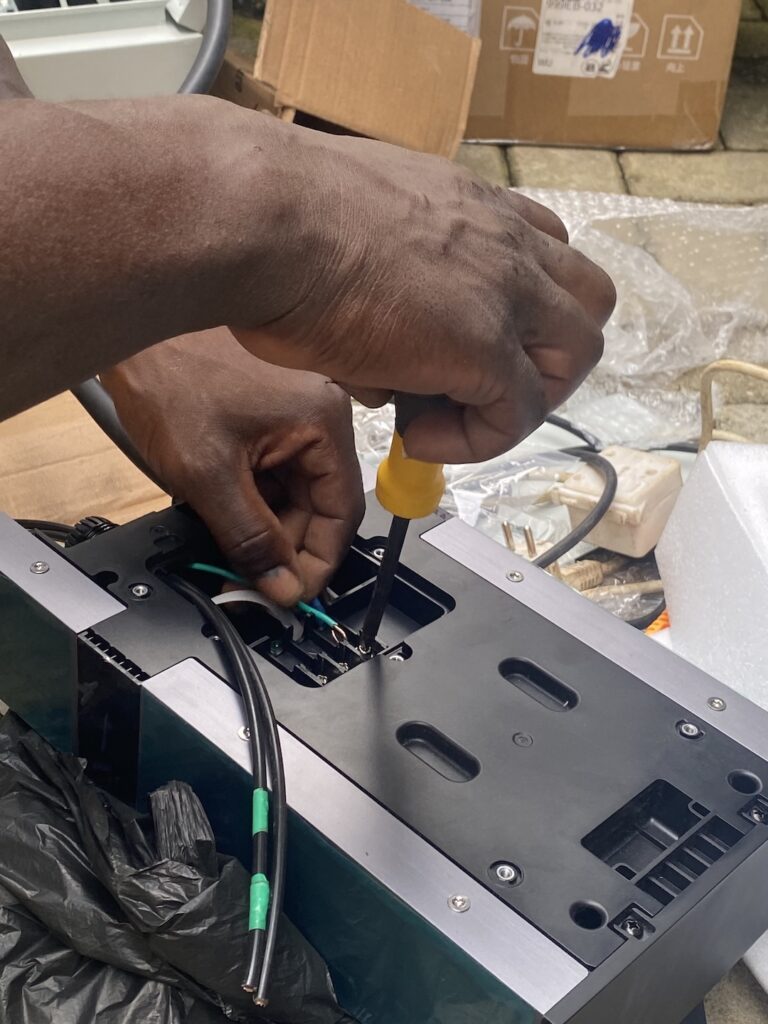
Of all the installations we are called out to repair, one item is missing or wrong more often than any other, and it is not the charger. It is the residual current protection on the circuit feeding it.
Why an EV circuit is different
The charger on your wall does not charge the battery. The car does, through an onboard converter that turns the alternating current you supply into the direct current the battery needs. Under certain fault conditions that converter can push a small, smooth DC residual current back onto your installation.
An ordinary AC-type residual current device cannot detect that DC component. Worse, a sustained DC residual current can saturate the device core and blind it to a subsequent AC fault, which is the failure mode that matters. The protection is present, it looks fine, and it does not operate when it needs to.
What the standard requires
IEC 61851-1, the international standard for conductive charging systems for electric vehicles, requires that an EV charging point provides detection of DC fault current at 6mA. There are two compliant ways to achieve that:
- A Type B RCD on the charger circuit, which detects both AC and smooth DC residual currents; or
- A charger with 6mA DC fault detection built into the unit, protected by a Type A device on the supply side.
Plenty of chargers sold in Nigeria do have the detection built in. Plenty do not. The problem is that nobody asks, so nobody knows which one is on the wall.
How to check
Ask whoever installed your charger a single question: does my installation have a Type B RCD, or does the charger have 6mA DC fault detection built in? If the answer is a confident one of those two, you are fine. If the answer is vague, that is the answer.
The other items we most often find missing on existing work, in rough order of frequency:
No dedicated circuit. The charger shares a ring with air conditioning, a pump or a freezer, and the main breaker trips at two in the morning.
No measured earth. Many Abuja properties have no driven electrode at all, or one installed years ago that has never been tested. Every protective measure on the circuit depends on that reading.
Undersized cable. A 40 metre run across a compound needs a bigger conductor than a five metre run. Undersized cable means voltage drop, heat, and a charger that quietly throttles.
No usable changeover. A charger fed from a generator or inverter without a proper neutral reference will fault, and can be damaged. If the backup side is being built at the same time, Abuja Solar & Energy Company handles the solar and storage design.
The regulatory position in Nigeria
Electrical installations in Nigeria fall under the Nigerian Electricity Supply and Installation Standards Regulations 2015, administered by NEMSA. An EV charger is a new final circuit on your installation and should be treated with the same rigour and the same paperwork as any other.
This matters more here than it would elsewhere. With barely a dozen public charging sites in the whole country, the circuit in your own compound is not a convenience, it is the entire refuelling strategy, and it runs at close to full load for hours at a time.
We test every installation on completion and hand over the readings: earth loop impedance, RCD trip time, insulation resistance and continuity. If you have an existing charger and nobody ever gave you those numbers, it is worth having it looked at. Call 0706 727 6002 and we will be with you within 6 hours anywhere in Abuja.
References: IEC 61851-1, conductive charging systems for electric vehicles. Nigerian Electricity Supply and Installation Standards Regulations 2015.