
EV Charger Installation FAQs
Everything we are asked most often about installing, running, repairing and paying for electric vehicle charging in Abuja, answered properly rather than in one line. Longer pieces on DC-fault protection, what charging actually costs and Nigeria’s charging network are in our news section. If yours is missing, call 0706 727 6002 and ask.
Getting started
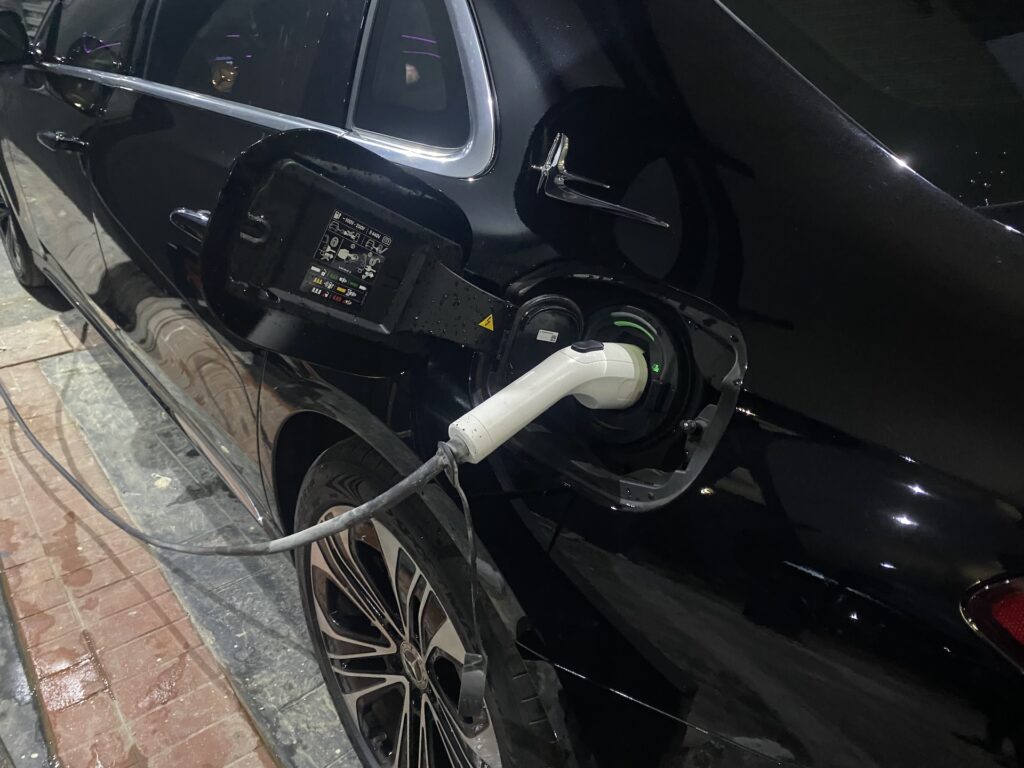
A dedicated charging circuit at home, with a wall-mounted charger on it. For nearly every EV sold in this market that means a 7.4kW Type 2 AC unit on a single-phase supply. Before we specify anything we check that your board has spare capacity, that your earth is sound, and how far the run is from the board to where the car parks.
You can occasionally, and you should keep it for travel. What you should not do is make it your daily method. It pulls close to the limit of a domestic socket outlet for eight hours or more at a stretch, and socket outlets are not designed for that duty cycle. Warm plugs and browned socket faces are the usual result.
A straightforward single-phase job with a short run and a usable earth is normally one day. Long compound runs, trenching, a new earth electrode, three-phase work or estate approvals extend it. You get a realistic duration at survey.
Yes, on anything but the simplest job. We can often give a close estimate on the phone if you send a photo of your distribution board and tell us the distance to the parking, but the figure is confirmed on site.
All of Abuja and the wider Federal Capital Territory, with twenty-eight districts covered in detail on their own pages. Wherever you are in the territory, we are with you for inspection and evaluation within 6 hours.
Power, speed and equipment
Roughly 40km of range per hour for a typical electric saloon or compact SUV, against roughly 10km per hour from a 13A socket. An eight-hour overnight window on 7.4kW covers almost any Abuja commuting pattern.
Only if you have a genuine three-phase supply and a reason to charge in three hours rather than eight. On a single-phase supply a 22kW unit will charge at about 7.4kW no matter what the box says, so you would be paying for a sticker.
Almost certainly Type 2 for AC charging, which covers MG, BYD, GAC, Geely, Hyundai, Kia and most Teslas sold here. DC rapid charging uses CCS2 on most of these. If your vehicle is an import with something different, we confirm before ordering.
In turn, yes, and some units support load sharing across two outlets. The limit is your supply: if both cars charge at once, the design has to allow for the combined load.
Only for app control, scheduling and remote diagnostics. The charging itself works without it. In practice the most common app complaint we get is Wi-Fi range from the house to an outdoor unit, which is a solvable problem.
Some are, many are not. The things worth paying for are genuine IP65 protection, built-in DC fault detection, a decent contactor, and a supplier who will still exist when you need a part. We are happy to install a unit you supply, and we will tell you honestly if it worries us.
Safety and standards
Because a car’s onboard charger can produce smooth DC residual current under fault conditions, and a standard AC-type RCD cannot see it. Worse, that DC component can blind the AC-type device so it fails to trip on a later AC fault. IEC 61851-1 requires 6mA DC fault detection, provided either by a Type B RCD or built into the charger. It is the item most often missing on installations we are called to fix.
Because the protective measures on the circuit depend on it. Many Abuja properties have no driven electrode, or one installed years ago that has never been tested. Without a proven low-impedance earth, a fault that should trip a device instead sits on the metalwork. We measure and record the reading rather than assuming.
Yes, with correctly rated equipment. Charging equipment is designed for outdoor use, and the connection is not energised until the car and charger have completed a handshake. What is not safe is an unsealed enclosure, a gland fitted upward, or a damaged cable, all of which we look for at service.
Electrical installations fall under the Nigerian Electricity Supply and Installation Standards Regulations 2015, administered by NEMSA. An EV charger is a new final circuit and should be treated with the same rigour and paperwork as any other. We test on completion and give you the results.
Surges can, and exposed sites are more at risk. Surge protection at the board is worth having anywhere in the FCT and is close to essential on open commercial sites and rooftops.
Cost and running
It depends on the unit, the cable run, the route, the state of your earthing, the spare capacity at your board and whether you want it to work during an outage. We survey and give you one written figure. Call 0706 727 6002 with your details for a close estimate first.
On the AEDC Band A tariff of N209.50 per kWh (NERC MYTO, from December 2025), an electric car using 18kWh per 100km costs roughly N3,770 per 100km. The same distance in a petrol car at 10 litres per 100km costs about N15,960 at the National Bureau of Statistics May 2026 average of N1,596.25 per litre.
Usually not. At the NBS May 2026 diesel average of N3,277 per litre, and after generator efficiency losses, charging from diesel can cost more per kilometre than petrol in the car you replaced. It is sometimes still worth it for convenience, but it should be a decision rather than an accident.
It will raise it, and it should still be far less than what you stop spending on fuel. Roughly, every 100km of driving adds about 18kWh to your bill. What matters more is your tariff band and whether you are also charging from an inverter.
Yes, particularly for commercial and public sites, where equipment is used by strangers and should be inspected at least twice a year. For a home unit, an annual inspection is sensible.
Commercial, estates and repairs
What the shared transformer can take, how many residents are likely to want chargers over the next two years, and whether load-managed shared infrastructure is cheaper than a series of individual installations. It usually is.
Yes, with sub-metered chargers and RFID or app authentication. You can bill per kWh, per session, or offer it free to guests and bill nobody. It changes which units we specify, so decide early.
Not with dynamic load management, which measures live site demand and shares the remaining headroom between active chargers. Without it, several chargers starting together is a straightforward route to tripping the incomer.
Yes, and it is a large part of what we do. We diagnose the installation as well as the unit, because the fault is more often in the circuit, the earth or the protective device than in the box.
Most often a shared circuit, an earthing problem, moisture ingress, or an incorrect protective device. It is a diagnostic job, not a reset job. Stop resetting it and have it tested.
Frequently. Moving the charger to a dedicated circuit, fitting the correct protective device, driving a proper earth electrode or re-sizing the cable fixes most of what we see, and the charger itself stays.
What our customers say
Rated 5.0 out of 5 from 3 Google reviews. Read every one of them, unedited, on our Google Business Profile.
“Great service and fast response I will give you guys a 9/10.”
Finding the charger: very easy
Kekeboro Obarijima · Google review
“Had a smooth charging experience at this Abuja EV charger installation, very user friendly. The fast electric vehicle charging and reliable public EV power make it the best spot in the FCT. Will definitely be back.”
john mmoh · Google review
“Great service.”
HID ACADEMY · Google review
Still not answered?
Call 0706 727 6002 or send a WhatsApp message. We would rather spend five minutes on the phone than have you guess.
On site for inspection within 6 hours, anywhere in the FCT. Open 24 hours, seven days a week.